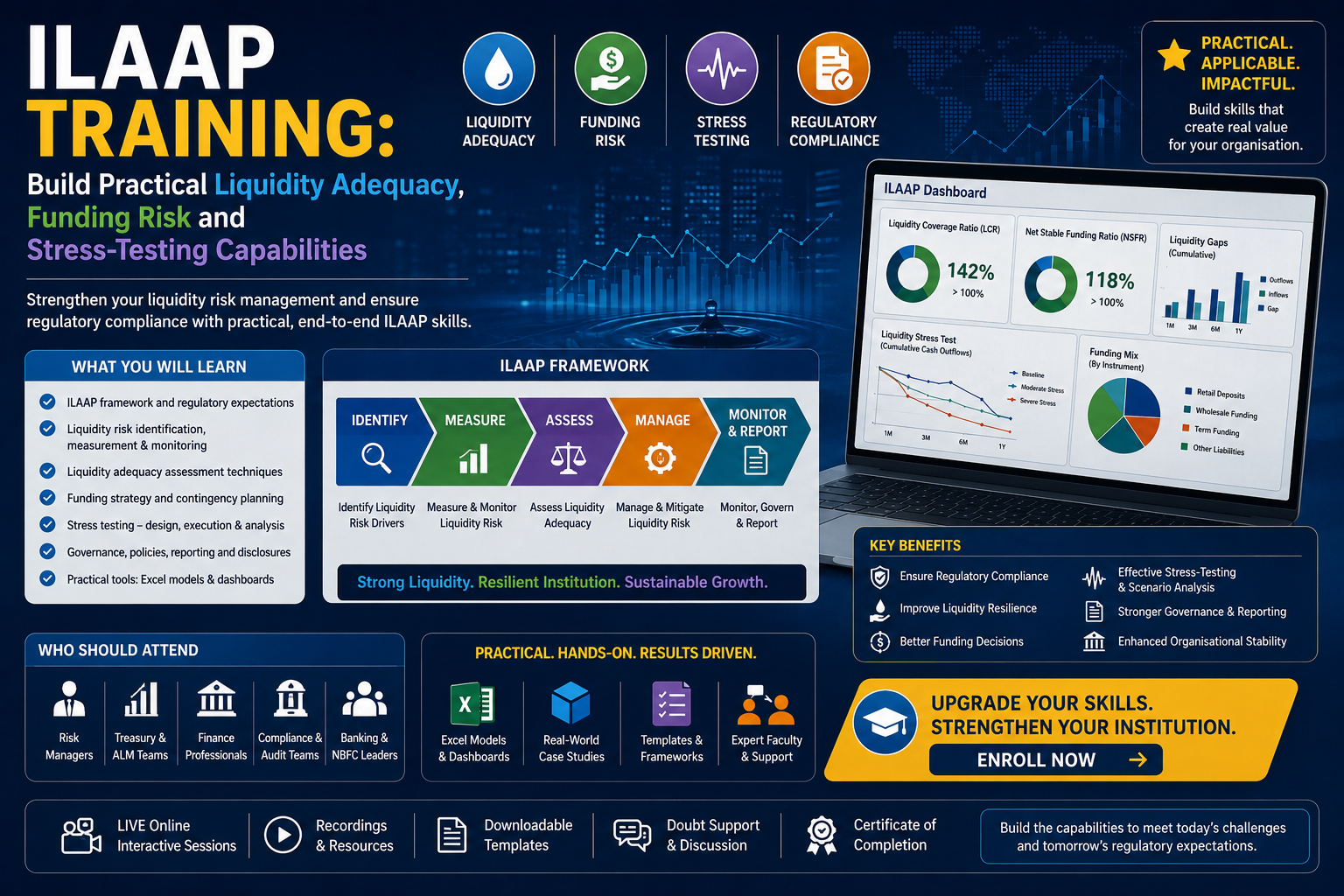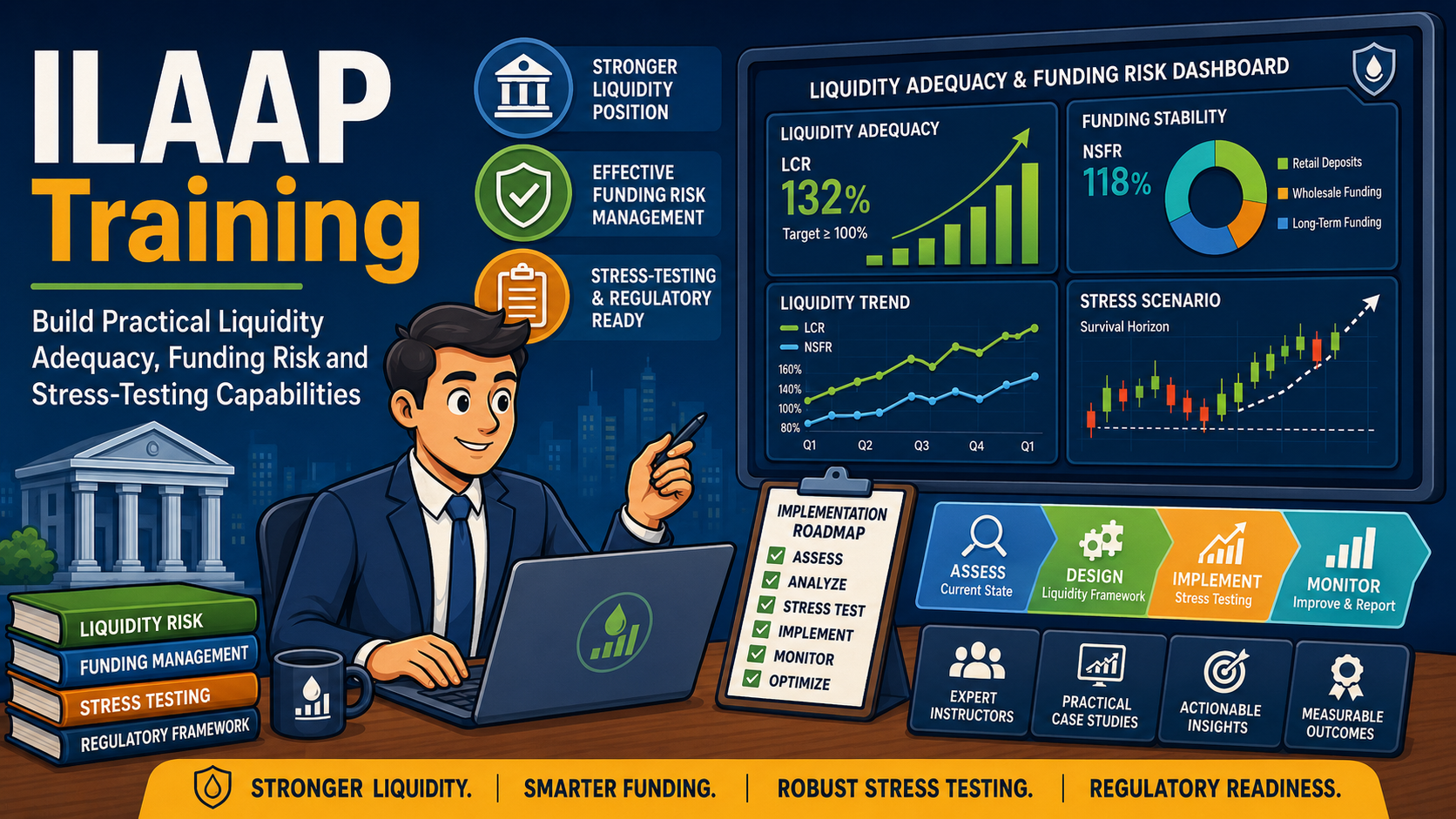
Liquidity problems can destabilise a financial institution much faster than many other risk events.
A bank may appear profitable and adequately capitalised but still face serious difficulty when it cannot meet payment obligations, replace maturing funding or convert assets into cash quickly enough. Managing this exposure requires more than monitoring a few regulatory ratios.
It requires a structured understanding of cash flows, funding sources, liquidity buffers, depositor behaviour, collateral, stress scenarios, management actions and governance.
This is the purpose of the Internal Liquidity Adequacy Assessment Process, commonly known as ILAAP.
A practical ILAAP training programme helps banking and risk professionals understand how an institution identifies, measures, manages and monitors liquidity and funding risk under both normal and stressed conditions. It also explains how liquidity-risk analysis should influence risk appetite, business planning, funding strategy, contingency planning and senior-management decisions.
The European Central Bank describes ILAAP as an important component of a credit institution’s risk-management framework. Its guidance emphasises forward-looking risk identification, effective controls, adequate liquidity buffers and the integration of liquidity considerations into the institution’s overall management process.
For professionals, the real challenge is not memorising the definition of ILAAP. It is learning how to translate regulatory principles into an operational liquidity-risk framework.
That is where high-quality ILAAP training becomes valuable.
What Is ILAAP?
ILAAP stands for Internal Liquidity Adequacy Assessment Process.
It is the internal process through which a financial institution evaluates whether it has sufficient liquidity and stable funding to support its business model and meet its obligations across different time horizons, including during periods of severe stress.
A sound ILAAP should help the institution answer questions such as:
- What are the organisation’s material liquidity and funding risks?
- How much liquidity is required under normal conditions?
- What happens when deposits leave faster than expected?
- How long can the institution survive without obtaining new funding?
- Is the liquidity buffer genuinely available during stress?
- Is funding excessively dependent on particular counterparties or markets?
- What management actions can be implemented during a crisis?
- Are contingency plans operationally realistic?
- Does the board understand the institution’s principal liquidity vulnerabilities?
- Is liquidity risk integrated into pricing, planning and strategic decisions?
The European Banking Authority’s guidelines specify the information supervisors may collect from institutions regarding ICAAP and ILAAP. This information supports the supervisory assessment of institutions’ internal capital and liquidity estimates as part of the Supervisory Review and Evaluation Process.
ILAAP should therefore not be treated merely as an annual report produced for regulatory submission. It should function as a continuous internal process connected to the institution’s day-to-day risk management.
Why Is ILAAP Important?
Liquidity risk can arise even when an institution satisfies standard regulatory ratios.
Ratios such as the Liquidity Coverage Ratio and Net Stable Funding Ratio provide important regulatory measures, but they do not capture every institution-specific vulnerability. Two banks with similar ratios may have very different deposit behaviour, funding concentrations, collateral positions, business models and access to markets.
ILAAP provides an institution-specific assessment.
It connects regulatory requirements with internal analysis of:
- Business-model vulnerabilities
- Funding concentrations
- Deposit stability
- Contractual and behavioural cash flows
- Intraday liquidity requirements
- Asset monetisation capacity
- Encumbered assets
- Collateral availability
- Contingent liabilities
- Off-balance-sheet commitments
- Market access
- Stress survival periods
- Recovery options
A strong ILAAP framework helps management understand not only whether the institution is compliant today, but whether it can remain viable when operating conditions deteriorate.
ILAAP Is a Process, Not Just a Document
One of the most common mistakes is treating ILAAP as a document-production exercise.
The final ILAAP document is important, but it is only evidence of a much broader process.
The underlying framework should include:
- Liquidity-risk governance
- Risk identification
- Risk measurement
- Risk appetite and limits
- Stress testing
- Liquidity-buffer management
- Funding planning
- Contingency funding
- Management reporting
- Independent review and validation
The ECB has clarified that ICAAP and ILAAP should operate as continuous processes supported by strong governance, regular review and documented approval arrangements throughout the year.
Similarly, the UK Prudential Regulation Authority expects an ILAAP to be updated annually or more frequently when changes in the institution’s business, strategy, activities or operating environment make the current liquidity or funding assessment inadequate.
An effective ILAAP training course must therefore teach participants how the entire process works rather than merely showing them a sample report.
What Should Practical ILAAP Training Cover?
A professionally designed ILAAP training programme should connect regulatory expectations with models, data, governance and management decisions.
The following areas should form the core curriculum.
1. Liquidity-Risk Governance
ILAAP begins with governance.
Participants should understand the responsibilities of:
- The board
- Senior management
- Treasury
- Asset Liability Management Committee
- Risk-management teams
- Finance
- Business units
- Internal audit
- Independent validation functions
The management body should understand the institution’s liquidity position, material vulnerabilities, stress-testing results, available buffers and contingency options.
ILAAP training should explain how to establish:
- Clear ownership
- Committee responsibilities
- Escalation procedures
- Approval authorities
- Review frequencies
- Independent challenge
- Management-information standards
The ECB’s ILAAP guide places responsibility for implementation and key approvals on the management body. It also expects clear assignment of responsibilities, segregation of functions and regular internal review.
Governance cannot be reduced to adding a board signature to the final document. Management must understand and use the analysis.
2. Liquidity-Risk Appetite
The liquidity-risk appetite defines the nature and amount of liquidity risk the institution is prepared to accept.
An effective risk-appetite framework may include:
- Regulatory-ratio thresholds
- Survival-horizon limits
- Funding-concentration limits
- Deposit outflow thresholds
- Unencumbered asset requirements
- Counterbalancing-capacity limits
- Intraday liquidity limits
- Early-warning indicators
- Stress-testing thresholds
ILAAP training should show participants how these measures connect to:
- Business strategy
- Funding plans
- Product pricing
- Deposit acquisition
- Balance-sheet growth
- Contingency planning
- Recovery planning
A risk-appetite statement is ineffective when it exists separately from the institution’s operating decisions.
3. Liquidity-Risk Inventory
Before quantifying risk, an institution must identify the sources of liquidity and funding vulnerability relevant to its business model.
The risk inventory may cover:
- Retail deposit withdrawals
- Wholesale funding maturities
- Secured and unsecured funding
- Margin calls
- Collateral requirements
- Derivative cash flows
- Loan commitments
- Credit-line utilisation
- Securitisation structures
- Currency mismatches
- Intraday payment obligations
- Market-liquidity risk
- Funding concentration
- Asset encumbrance
- Reputational events
- Rating downgrades
- Operational disruptions
A strong ILAAP course should teach participants to distinguish between generic risks and risks genuinely material to the institution.
Using a copied risk inventory is not adequate. The inventory must reflect the organisation’s products, customers, geography, currency exposure, funding structure and operating model.
4. Contractual and Behavioural Cash-Flow Analysis
Contractual maturity does not always reflect actual customer behaviour.
For example:
- Some deposits contractually repayable on demand may remain relatively stable.
- Some customers may withdraw funds much faster during a crisis.
- Loans may prepay earlier than expected.
- Credit facilities may be drawn during stress.
- Maturing funding may not be renewable.
- Collateral requirements may increase suddenly.
Practical ILAAP training should explain how to construct liquidity cash-flow ladders across appropriate time buckets.
Participants should learn how to analyse:
- Contractual inflows
- Contractual outflows
- Behavioural adjustments
- Maturity mismatches
- Cumulative funding gaps
- Counterbalancing capacity
- Stressed net cash flows
- Survival horizon
The course should also explain how behavioural assumptions are developed, challenged, documented and back-tested.
5. Funding-Risk Assessment
Liquidity and funding are connected but not identical.
Liquidity concerns the institution’s ability to meet obligations when they fall due. Funding risk concerns the sustainability, stability, diversity and cost of the institution’s funding structure.
An ILAAP training programme should cover:
- Retail versus wholesale funding
- Secured versus unsecured funding
- Short-term versus long-term funding
- Funding by currency
- Counterparty concentration
- Product concentration
- Market dependence
- Deposit stability
- Funding renewal risk
- Funding costs
- Term structure
- Access to central-bank facilities
- Alternative funding sources
Participants should learn how to identify concentrations that may appear manageable during normal conditions but become dangerous during stress.
6. Liquidity Coverage Ratio and Net Stable Funding Ratio
ILAAP is broader than the Liquidity Coverage Ratio and Net Stable Funding Ratio, but participants must understand how these measures fit into the overall framework.
Liquidity Coverage Ratio
The LCR assesses whether the institution has sufficient high-quality liquid assets to withstand a short-term liquidity-stress period.
Net Stable Funding Ratio
The NSFR assesses whether the institution maintains an appropriately stable funding structure over a longer horizon.
A practical course should explain:
- Components of each ratio
- Data requirements
- Classification issues
- Management buffers
- Limitations
- Relationship with internal stress testing
- Interaction with the institution’s risk appetite
Regulatory compliance is not the same as internal liquidity adequacy. ILAAP must evaluate risks that may not be fully represented by regulatory ratios.
7. Liquidity Stress Testing
Stress testing is one of the most important parts of ILAAP.
The objective is to determine how the institution’s liquidity position changes under severe but plausible conditions.
Common scenario categories include:
Institution-specific stress
Examples may include:
- Credit-rating downgrade
- Loss of depositor confidence
- Reputational event
- Operational failure
- Deteriorating asset quality
- Sudden collateral calls
- Reduced market access
Market-wide stress
Examples may include:
- Financial-market disruption
- Interbank-market closure
- Sharp interest-rate movement
- Decline in asset-market liquidity
- System-wide deposit outflows
- Currency-market stress
- Macroeconomic deterioration
Combined stress
Combined scenarios bring institution-specific and market-wide pressures together.
They are usually more severe because the institution may experience increased cash outflows at the same time that funding and asset-sale options become restricted.
ILAAP training should teach participants to develop assumptions for:
- Deposit runoff
- Funding rollover
- Haircuts
- Asset monetisation
- Collateral calls
- Undrawn commitments
- Derivative exposures
- Currency movements
- Management actions
- Central-bank access
It should also explain how scenario severity can be supported, challenged and updated.
8. Reverse Stress Testing
Traditional stress testing asks:
What happens to the institution under a defined stress scenario?
Reverse stress testing asks:
What circumstances would cause the institution’s liquidity position or business model to become unviable?
This approach helps identify hidden vulnerabilities and combinations of events that may not be visible through standard scenarios.
Reverse stress testing may examine:
- Minimum viable survival horizon
- Exhaustion of liquid assets
- Loss of key funding sources
- Failure of planned management actions
- Breach of internal liquidity needs
- Entry into recovery or resolution conditions
The ECB has highlighted the connection between management buffers, adverse scenarios, reverse stress testing and recovery-plan triggers.
9. Liquidity Buffer and Counterbalancing Capacity
A liquidity buffer is useful only when the institution can access and monetise it during stress.
ILAAP training should examine:
- High-quality liquid assets
- Unencumbered assets
- Asset eligibility
- Operational availability
- Market depth
- Settlement time
- Haircuts
- Currency alignment
- Location of assets
- Legal restrictions
- Central-bank eligibility
- Asset encumbrance
Participants should understand the difference between an asset appearing liquid in a report and being operationally available when urgently required.
A sound course should include exercises involving:
- Buffer composition
- Stressed haircuts
- Monetisation time
- Counterbalancing capacity
- Liquidity value
- Buffer depletion
- Management-buffer calibration
10. Survival-Horizon Analysis
The survival horizon measures how long an institution can continue meeting its obligations under stress before its available liquidity is exhausted.
This requires analysis of:
- Opening liquidity resources
- Stressed inflows
- Stressed outflows
- Asset monetisation
- Collateral needs
- Management actions
- Funding availability
- Operational constraints
A strong ILAAP model should allow users to test different assumptions and observe their effect on the survival period.
This makes survival-horizon modelling especially suitable for practical Excel and Python exercises.
11. Contingency Funding Plan
A contingency funding plan defines how the institution will respond when liquidity conditions deteriorate.
The plan should include:
- Crisis indicators
- Escalation thresholds
- Decision-making responsibilities
- Communication procedures
- Funding options
- Asset-sale options
- Collateral mobilisation
- Central-bank access
- Customer-management actions
- Market communication
- Recovery-plan alignment
The course should distinguish between theoretical actions and actions that are operationally executable.
For example, “sell assets” is not a complete management action. The institution must know:
- Which assets can be sold
- Who has authority to sell them
- How long settlement takes
- What haircut may apply
- Whether the assets are already encumbered
- Whether selling them creates additional consequences
Practical ILAAP training should test the credibility, timing and capacity of management actions rather than accepting them at face value.
12. Early-Warning Indicators
Early-warning indicators help management detect deterioration before a liquidity crisis becomes severe.
Potential indicators include:
- Rapid deposit outflows
- Increased funding costs
- Reduced market access
- Declining collateral values
- Rating changes
- Widening credit spreads
- Concentration increases
- Abnormal customer behaviour
- Increased utilisation of committed facilities
- LCR or internal-limit deterioration
- Negative media events
- Intraday liquidity pressure
The training should explain how indicators are:
- Selected
- Calibrated
- Monitored
- Escalated
- Connected to contingency actions
An indicator without a defined response is merely a number on a dashboard.
13. Intraday Liquidity Risk
An institution may be solvent at the end of the day and still experience serious payment difficulties during the day.
Intraday liquidity analysis should consider:
- Payment and settlement obligations
- Timing mismatches
- Collateral usage
- Correspondent-banking activity
- Securities settlement
- Peak liquidity usage
- Operational disruptions
- Available intraday credit
This topic is especially relevant for institutions with significant payment, settlement, treasury or market activity.
14. Funds Transfer Pricing
Funds Transfer Pricing helps allocate liquidity and funding costs across business units, products and transactions.
A well-designed framework can help:
- Reflect the true cost of funding
- Price products more accurately
- Incentivise stable funding
- Discourage excessive liquidity consumption
- Improve profitability measurement
- Connect treasury decisions with business strategy
ILAAP training should explain how FTP can support liquidity-risk management rather than functioning only as an accounting allocation.
15. ILAAP Documentation and Management Information
A technically strong framework can still fail when the documentation is unclear, inconsistent or disconnected from management decisions.
The ILAAP document should explain:
- Business model
- Governance
- Risk appetite
- Risk inventory
- Measurement methodologies
- Assumptions
- Funding profile
- Liquidity buffer
- Stress-testing framework
- Management actions
- Contingency funding
- Limitations
- Validation and review
- Liquidity adequacy conclusion
The PRA expects ILAAP documentation to be specific to the institution and its business model rather than formulaic. It also warns against both excessively large documents and reports containing insufficient detail.
Good documentation is not about producing the longest report. It is about presenting a clear, defensible and internally consistent assessment.
ILAAP vs ICAAP
ILAAP and ICAAP are related but address different dimensions of financial resilience.
| Area | ILAAP | ICAAP |
|---|---|---|
| Full form | Internal Liquidity Adequacy Assessment Process | Internal Capital Adequacy Assessment Process |
| Primary focus | Liquidity and funding adequacy | Capital adequacy |
| Main question | Can the institution meet its obligations? | Can the institution absorb losses? |
| Typical risks | Funding outflows, liquidity gaps, asset monetisation, collateral and market access | Credit, market, operational, concentration, business and other material risks |
| Key techniques | Cash-flow gaps, survival horizon, liquidity stress testing and funding analysis | Capital planning, risk quantification and capital stress testing |
| Key outputs | Liquidity adequacy assessment | Capital adequacy assessment |
An institution can be adequately capitalised but unable to access sufficient cash. It can also hold liquid resources while facing inadequate capital against long-term losses.
That is why ICAAP and ILAAP should be connected, but they should not be confused.
Relationship Between ILAAP and IRRBB
ILAAP and Interest Rate Risk in the Banking Book are closely connected because interest-rate movements can affect:
- Deposit behaviour
- Funding costs
- Deposit migration
- Loan prepayments
- Market value of liquid assets
- Collateral values
- Customer pricing
- Balance-sheet structure
An integrated training programme covering ICAAP, ILAAP and IRRBB can help participants understand how capital, liquidity, interest-rate exposure and balance-sheet decisions interact.
However, combining these topics is useful only when each module receives sufficient depth. Compressing three complex frameworks into a superficial one-day overview creates awareness, not working capability.
Who Should Attend ILAAP Training?
ILAAP training is particularly relevant for:
- Liquidity-risk analysts
- Treasury professionals
- ALM professionals
- Banking-risk managers
- Finance professionals
- Regulatory-reporting teams
- Risk consultants
- Internal auditors
- Model validators
- Compliance teams
- Senior managers
- Board-risk committee members
- Professionals preparing for banking-risk roles
The required depth should vary by audience.
Senior managers need a clear understanding of governance, risk appetite, stress results and management decisions. Analysts require deeper exposure to data, cash-flow models, assumptions and scenario calculations.
Corporate training should therefore be adapted to participant roles rather than delivering identical material to everyone.
Why Banks Need Corporate ILAAP Training
ILAAP is cross-functional.
Treasury may manage funding. Risk may develop scenarios. Finance may supply balance-sheet projections. Business teams may determine customer assumptions. Technology teams may support data and systems. Internal audit may review governance and controls.
When these teams work with different definitions and assumptions, the resulting ILAAP becomes inconsistent.
Corporate ILAAP training can help organisations:
- Establish a common risk language
- Clarify roles and ownership
- Improve modelling consistency
- Strengthen documentation
- Challenge unsupported assumptions
- Connect ILAAP with risk appetite
- Align stress testing and contingency planning
- Improve management reporting
- Prepare teams for internal and supervisory review
- Reduce dependency on a small number of specialists
Training should use the institution’s business model, data structure and regulatory context wherever confidentiality and permissions allow.
Online, Classroom or Hybrid ILAAP Training?
Each format has advantages.
Online ILAAP training
Suitable for geographically distributed teams and professionals requiring flexible access.
It should include:
- Live sessions
- Recordings
- Model demonstrations
- Assignments
- Discussion support
- Downloadable resources
Classroom training
Suitable for concentrated workshops, team interaction and governance discussions.
Hybrid ILAAP training
A hybrid format can combine recorded conceptual learning with live workshops, case studies and model-building sessions.
The format matters less than the quality of practical application. A live class that only reads slides is not meaningfully better than a recording.
Why Excel and Python Matter in ILAAP Training
ILAAP is not fundamentally a software course, but analytical tools make the framework operational.
Excel can be used for:
- Cash-flow ladders
- Funding-gap analysis
- Liquidity-buffer calculations
- Stress assumptions
- Survival-horizon modelling
- Scenario comparisons
- Management dashboards
- Sensitivity testing
Python can be used for:
- Large datasets
- Automated stress testing
- Behavioural analysis
- Scenario engines
- Deposit analysis
- Repeatable reporting
- Data-quality checks
- Visualisation
- Back-testing assumptions
The goal is not to add Python merely because it sounds advanced.
A model should use the tool appropriate to its complexity, data volume, governance requirements and intended users. A transparent Excel model may be more useful than poorly governed Python code. Conversely, a large and frequently repeated process may be unsuitable for a manually maintained spreadsheet.
What Makes an ILAAP Course Practical?
A practical course should require participants to work through a complete case study.
The case study could include:
- Analysing a simplified bank balance sheet
- Creating contractual cash-flow buckets
- Applying behavioural assumptions
- Identifying funding concentrations
- Designing stress scenarios
- Calculating stressed cash flows
- Estimating counterbalancing capacity
- Determining survival horizon
- Testing management actions
- Preparing a liquidity-risk dashboard
- Drafting an adequacy conclusion
- Presenting the results to a simulated management committee
This is far more valuable than memorising definitions or copying a generic ILAAP template.
Common ILAAP Mistakes
Treating ILAAP as a regulatory formality
This produces a report that is disconnected from actual liquidity management.
Using generic stress scenarios
Scenarios must reflect the institution’s business model and vulnerabilities.
Applying unsupported assumptions
Deposit runoff, rollover rates, haircuts and management actions require evidence and challenge.
Ignoring operational constraints
An asset may be legally available but operationally impossible to monetise quickly.
Double-counting liquidity resources
The same asset or funding source should not support multiple actions simultaneously without justification.
Assuming all management actions will work
Actions must be feasible under the exact stress conditions being modelled.
Weak board involvement
Approval without understanding does not demonstrate effective governance.
Poor connection with recovery planning
ILAAP stress, management buffers, contingency actions and recovery triggers should be logically aligned.
Excessive documentation
A long report does not compensate for weak analysis.
Insufficient independent review
Models, assumptions and processes require challenge, validation and remediation.
How to Choose the Right ILAAP Training Course
Before enrolling, assess whether the course provides:
- Clear coverage of the ILAAP framework
- Liquidity and funding-risk concepts
- LCR and NSFR context
- Behavioural cash-flow modelling
- Stress-testing exercises
- Survival-horizon analysis
- Contingency funding planning
- Liquidity-buffer analysis
- Governance and documentation
- Practical Excel or Python models
- Assignments or assessments
- Instructor interaction
- Relevant case studies
- Certification with meaningful assessment
Avoid choosing a programme purely because it uses terms such as “advanced,” “global” or “certified.”
Ask to see the syllabus, training method and expected deliverables.
ILAAP Training with Peaks2Tails
Peaks2Tails positions its learning platform around quantitative finance, risk modelling and practical Excel and Python implementation.
Its integrated treasury-risk modelling programme describes coverage across ICAAP, ILAAP, IRRBB and CSRBB. Published learning deliverables include concept lectures, mathematics and statistics support, Excel models, Python code, presentation materials, readings and practice questions.
For ILAAP learners, the practical value should come from connecting regulatory principles with:
- Liquidity cash-flow models
- Funding analysis
- Stress testing
- Survival-horizon calculations
- Management-buffer assessment
- Contingency planning
- Governance
- Documentation
- Excel and Python implementation
The objective should not be to help participants repeat terminology. It should be to help them understand, build, challenge and explain a liquidity-adequacy framework.
Frequently Asked Questions
What is ILAAP training?
ILAAP training teaches participants how financial institutions identify, measure, manage, monitor and document liquidity and funding risks under normal and stressed conditions.
What is the full form of ILAAP?
ILAAP stands for Internal Liquidity Adequacy Assessment Process.
Is ILAAP the same as liquidity reporting?
No. Liquidity reporting is one component of the wider framework. ILAAP also includes governance, risk appetite, funding analysis, stress testing, liquidity buffers, contingency planning and management assessment.
Is ILAAP the same as LCR?
No. The Liquidity Coverage Ratio is a regulatory liquidity measure. ILAAP is a broader institution-specific assessment of liquidity and funding adequacy.
What is the difference between ICAAP and ILAAP?
ICAAP focuses primarily on capital adequacy and loss absorption. ILAAP focuses on liquidity and funding adequacy and the ability to meet obligations when due.
Does an ILAAP course cover stress testing?
A serious ILAAP course should cover institution-specific, market-wide, combined and reverse stress-testing approaches.
Is ILAAP relevant only to regulators?
No. Its analysis should support treasury management, funding planning, pricing, risk appetite, contingency planning and strategic decision-making.
Can ILAAP training be delivered online?
Yes. Online delivery can be effective when it includes live interaction, model demonstrations, assignments, case studies and access to learning resources.
Is Python compulsory for ILAAP?
No. Python is useful for automation, large datasets and scenario analysis, but it is not compulsory for every framework. Excel remains useful for transparent modelling and management communication.
Who should take ILAAP training?
The course is suitable for treasury, ALM, liquidity-risk, finance, regulatory-reporting, consulting, audit, validation and senior-management professionals.
Is ILAAP completed once a year?
The formal document may follow an annual cycle in some jurisdictions, but the underlying ILAAP should operate as a continuous risk-management process. Regulatory requirements and submission practices vary by jurisdiction.
Conclusion: ILAAP Training Must Build Decision-Making Capability, Not Just Regulatory Awareness
ILAAP is not simply a liquidity report, a regulatory ratio or a document prepared once a year.
It is the institution’s internal assessment of whether its liquidity resources, funding structure, governance and contingency arrangements are sufficient to support its business model under normal and stressed conditions.
That assessment must be credible.
It must be based on institution-specific risks, defensible assumptions, realistic stress scenarios and operationally available liquidity resources. It must consider how customers, counterparties and markets may behave when confidence deteriorates. It must also recognise that actions available during normal conditions may become expensive, delayed or completely unavailable during a genuine crisis.
This is why effective ILAAP training cannot be limited to definitions and presentation slides.
Professionals need to understand how to construct cash-flow ladders, analyse funding concentrations, design stress scenarios, estimate liquidity buffers, calculate survival horizons and evaluate contingency actions. They must also understand how model outputs connect with the risk appetite, funding plan, recovery framework and strategic decisions of the institution.
The governance dimension is equally important.
Senior management and the board must be able to understand the institution’s principal liquidity vulnerabilities and the assumptions underlying the adequacy conclusion. They must know which indicators signal deterioration, which actions are available and when escalation is required.
A technically sophisticated model that decision-makers cannot understand is not an effective ILAAP.
Similarly, a polished report based on generic assumptions is not evidence of sound liquidity-risk management.
The value of ILAAP lies in its ability to force an institution to confront difficult questions before a crisis occurs:
- Which funding sources are genuinely stable?
- How quickly could deposits leave?
- Which assets could actually be monetised?
- How severe could collateral demands become?
- How long could the institution survive?
- Which management actions are realistic?
- At what point would the recovery plan need to be activated?
- Does the institution have sufficient data, governance and operational capacity to respond?
Practical ILAAP training builds the ability to answer these questions systematically.
For individual professionals, this capability can strengthen expertise across treasury, liquidity risk, ALM, regulatory consulting, model validation and banking-risk management.
For financial institutions, it can improve consistency between risk, treasury, finance, business and senior-management teams. It can also strengthen stress-testing practices, management reporting, contingency planning and the quality of the overall liquidity-adequacy assessment.
The correct objective is therefore not merely to complete ILAAP training or obtain another certificate.
The objective is to develop professionals who can identify liquidity vulnerabilities, challenge assumptions, build credible models, interpret results and support better financial decisions before stress becomes a crisis.