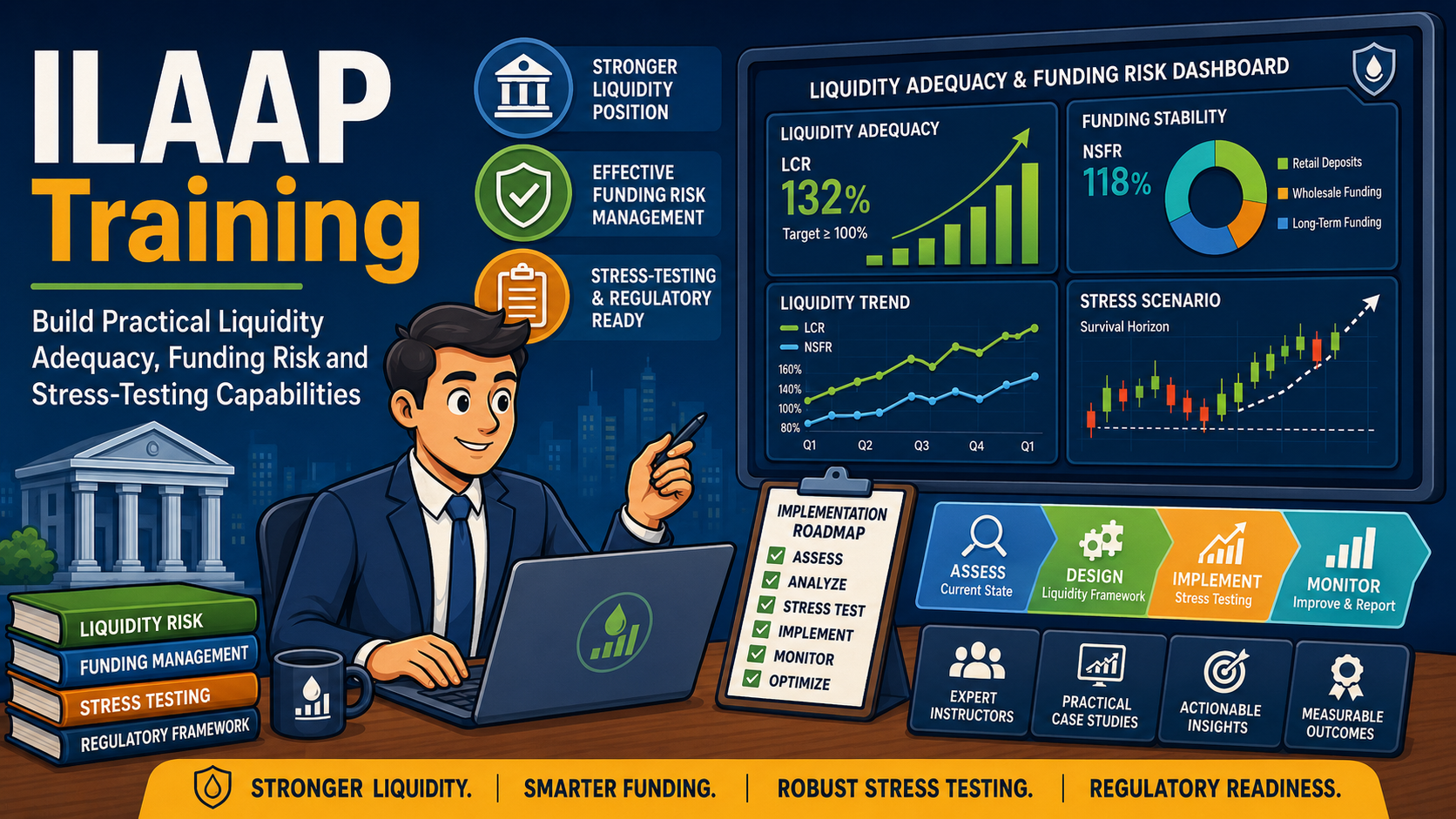
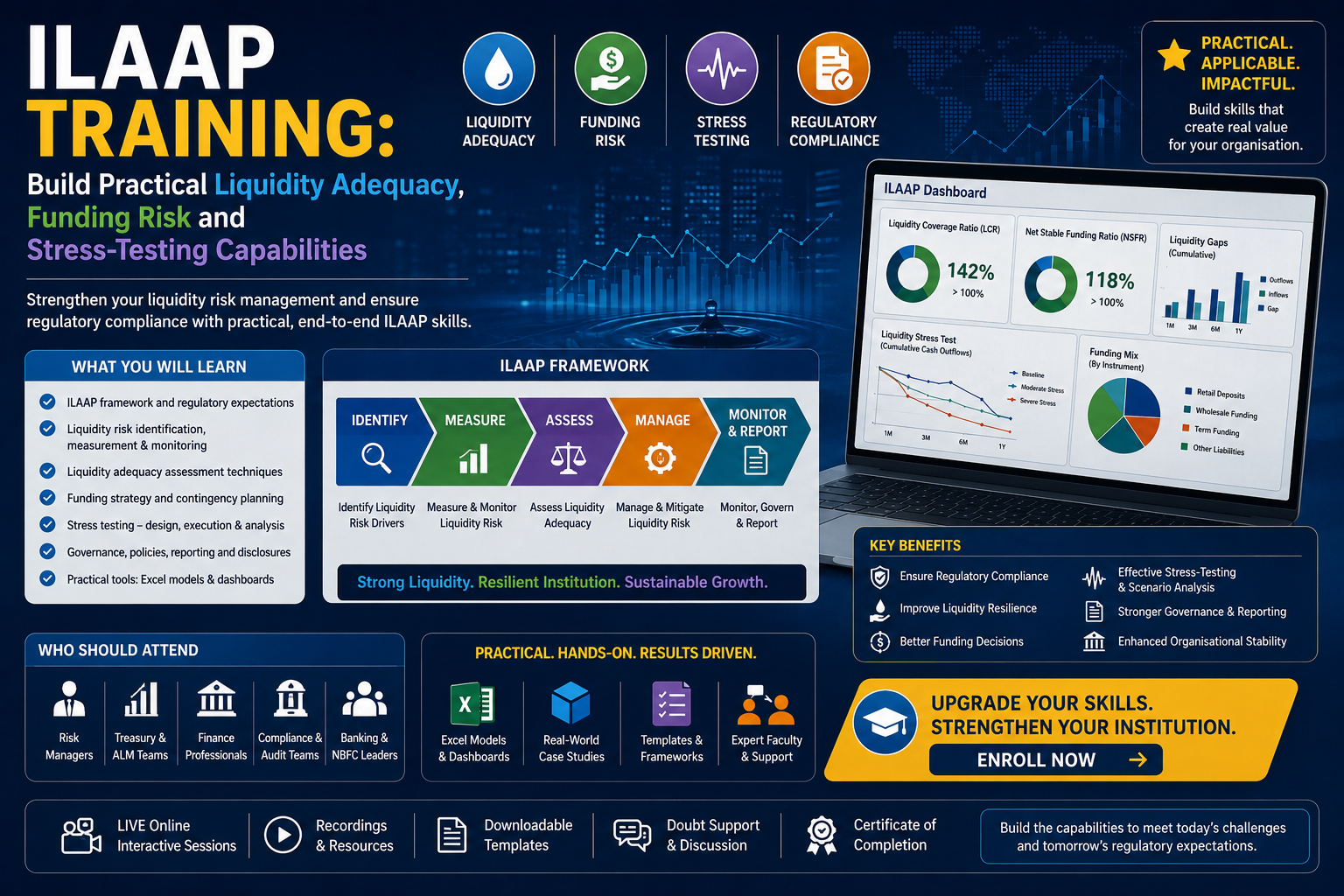
ILAAP Training: Master Liquidity Adequacy, Funding Risk and Stress Testing
SEO Information
Meta Title: ILAAP Training: Liquidity Risk and Stress Testing Course
Meta Description: Build practical ILAAP skills in liquidity-risk assessment, funding analysis, stress testing, contingency planning, governance and regulatory reporting.
Suggested URL Slug: ilaap-training
Primary Keyword: ILAAP training
Secondary Keywords:
- ILAAP training online
- ICAAP and ILAAP training
- ILAAP course
- liquidity risk training
- liquidity stress testing course
- funding risk management training
- ICAAP ILAAP IRRBB training
- banking risk training
- treasury risk management course
- asset liability management training
- liquidity adequacy assessment
- liquidity risk modelling
- LCR and liquidity risk training
- contingency funding plan training
- ILAAP certification
- ILAAP workshop online
ILAAP Training: Build Practical Liquidity Adequacy, Funding Risk and Stress-Testing Capabilities
Liquidity risk is one of the fastest-moving threats faced by banks and financial institutions.
A bank may appear profitable. It may report an acceptable capital position. Its assets may exceed its liabilities. Yet it can still enter a serious crisis when it cannot generate enough cash to meet payment obligations, replace maturing funding, respond to deposit withdrawals or monetise assets without taking unacceptable losses.
That is why liquidity management cannot be reduced to monitoring one regulatory ratio.
Banks need a structured, forward-looking process for identifying liquidity vulnerabilities, quantifying potential cash-flow gaps, assessing funding stability, maintaining sufficient liquidity buffers and preparing realistic actions for periods of stress.
This is the purpose of the Internal Liquidity Adequacy Assessment Process, commonly known as ILAAP.
Professional ILAAP training helps banking, treasury and risk professionals move beyond definitions and understand how liquidity adequacy is evaluated in practice. It connects regulation, governance, cash-flow modelling, funding analysis, stress testing, risk appetite, contingency planning and senior-management decision-making.
The European Central Bank describes a sound ILAAP as a comprehensive process involving liquidity-risk assessment, governance, escalation processes, liquidity buffers, stable funding and forward-looking management of material risks. (ECB Banking Supervision)
What Is ILAAP?
ILAAP stands for Internal Liquidity Adequacy Assessment Process.
It is the institution-specific process through which a bank evaluates whether it has sufficient liquidity resources and a sufficiently resilient funding structure to remain operational under both normal and stressed conditions.
A proper ILAAP should help management answer questions such as:
- Can the institution meet its obligations when they fall due?
- How long can the institution survive under a severe liquidity shock?
- Which deposits or wholesale funding sources are most likely to leave?
- How much collateral can be mobilised during stress?
- Are the institution’s liquidity buffers genuinely available?
- What happens when secured or unsecured markets become unavailable?
- Which legal entities, currencies or business lines create liquidity concentrations?
- Are proposed management actions realistic and operationally executable?
- Does the funding strategy support the institution’s business plan?
- What escalation process will be followed when liquidity deteriorates?
The process is expected to be forward-looking, proportionate to the institution’s nature and complexity, and integrated with strategic planning and risk management rather than treated as an isolated compliance document. (ECB Banking Supervision)
Why Is ILAAP Important?
Liquidity problems can develop rapidly.
Credit losses may emerge over months or years. A liquidity crisis can intensify within days or even hours when depositors withdraw funds, lenders refuse to renew facilities, collateral values fall or market confidence disappears.
ILAAP helps an institution evaluate whether it can continue meeting obligations across multiple time horizons and under institution-specific stress conditions.
It also helps management understand:
- How dependent the institution is on unstable funding
- Whether funding is sufficiently diversified
- Whether liquid assets can be monetised quickly
- Whether contractual cash flows reflect realistic customer behaviour
- Whether intraday liquidity needs are being captured
- Whether liquidity buffers are available in the correct entity and currency
- Whether contingency actions can be implemented before available liquidity is exhausted
The Basel Committee’s liquidity-risk principles emphasise strong governance, firm-wide liquidity-risk management, appropriate risk measurement, stress testing, collateral management and contingency funding planning. (Bank for International Settlements)
ILAAP Is More Than LCR Compliance
One of the most common mistakes in liquidity-risk management is treating ILAAP as an extension of the Liquidity Coverage Ratio.
The LCR is an important regulatory measure. Its purpose is to promote short-term resilience by requiring an adequate stock of unencumbered high-quality liquid assets to cover net cash outflows during a prescribed 30-day liquidity stress scenario. (Bank for International Settlements)
However, an acceptable LCR does not automatically prove that an institution has an effective ILAAP.
ILAAP is broader because it should consider:
- Institution-specific vulnerabilities
- Multiple stress horizons
- Intraday liquidity
- Funding concentration
- Currency mismatches
- Legal-entity restrictions
- Asset encumbrance
- Collateral availability
- Behavioural cash flows
- Business-plan implications
- Recovery options
- Governance weaknesses
- Risks not fully captured by minimum regulatory metrics
Regulatory minimums provide a common baseline. They cannot capture every institution’s business model, funding structure, customer behaviour or operational constraints. Official supervisory guidance therefore distinguishes compliance with minimum liquidity standards from the broader internal assessment required under ILAAP. (OSFI)
Any ILAAP course that focuses only on calculating LCR is incomplete.
What Should Practical ILAAP Training Cover?
A useful ILAAP training programme should teach how the individual elements of liquidity-risk management work together.
Participants should learn not merely what each term means, but how to construct, challenge and interpret an integrated liquidity-adequacy framework.
1. Liquidity-Risk Governance
Liquidity governance establishes who is responsible for identifying, measuring, monitoring, challenging and escalating liquidity risk.
Training should explain the respective roles of:
- The board or management body
- Senior management
- Asset Liability Committee
- Treasury
- Independent risk management
- Finance
- Business units
- Compliance
- Internal audit
- Model validation
- Technology and data teams
The ECB expects the management body to approve key ILAAP elements, understand the institution’s liquidity position and provide a liquidity adequacy statement supported by ILAAP results. (ECB Banking Supervision)
A governance module should also address:
- Approval authorities
- Risk ownership
- Escalation thresholds
- Reporting frequency
- Limit breaches
- Independent review
- Model validation
- Data accountability
- Documentation standards
- Three-lines-of-defence responsibilities
Governance is not administrative decoration. A sophisticated liquidity model has limited value when responsibilities are unclear or senior management does not challenge its assumptions.
2. Liquidity-Risk Identification
An institution cannot assess liquidity adequacy correctly unless it first identifies all material sources of liquidity and funding risk.
ILAAP training should cover risks arising from:
- Retail deposit withdrawals
- Corporate deposit concentration
- Wholesale funding maturities
- Secured funding dependence
- Unsecured market closure
- Margin and collateral calls
- Derivative cash flows
- Undrawn credit commitments
- Guarantees
- Securitisation structures
- Off-balance-sheet exposures
- Foreign-currency funding
- Intraday payment obligations
- Asset encumbrance
- Market-value deterioration
- Rating downgrades
- Reputational events
- Operational disruption
- Contagion between group entities
Risk identification should initially be performed on a gross basis. Management should not prematurely assume that mitigation actions will work exactly as planned.
3. Contractual and Behavioural Cash-Flow Analysis
Contractual maturity schedules provide a starting point, but they rarely represent the complete economic reality.
Customers may withdraw deposits before contractual maturity. Some deposits without fixed maturity may remain stable. Borrowers may draw committed credit lines during stress. Loans may prepay. Assets expected to mature may be rolled over for business reasons.
Therefore, ILAAP training should explain the difference between:
- Contractual cash flows
- Expected behavioural cash flows
- Stressed behavioural cash flows
- Business-plan cash flows
- Management-adjusted cash flows
Professionals should understand how assumptions are developed for:
- Non-maturity deposits
- Term-deposit rollover
- Loan prepayments
- Credit-line utilisation
- Wholesale funding renewal
- Asset sales
- Collateral calls
- Intercompany funding
- Customer concentration
These assumptions should be justified with internal data, expert judgement and suitable validation. Blindly applying generic runoff rates creates false precision.
4. Maturity-Ladder and Liquidity-Gap Analysis
Liquidity-gap analysis compares expected cash inflows and outflows across defined time buckets.
A practical training programme should demonstrate how to build a maturity ladder covering horizons such as:
- Intraday
- Overnight
- Two to seven days
- Eight days to one month
- One to three months
- Three to six months
- Six to twelve months
- Beyond one year
Participants should learn to calculate:
- Periodic liquidity gaps
- Cumulative liquidity gaps
- Survival horizons
- Funding requirements
- Buffer utilisation
- Currency-specific gaps
- Entity-specific gaps
- Stress-adjusted gaps
Training should also expose the weakness of a mechanical gap report. A negative gap is not meaningful without understanding whether cash inflows are reliable, assets are monetisable and funding actions are operationally available.
5. Liquidity Buffers and Counterbalancing Capacity
Liquidity buffers are resources that can be used to meet cash requirements during stress.
However, not every asset shown on a balance sheet is genuinely available as liquidity.
ILAAP training should teach participants to evaluate:
- Asset eligibility
- Market liquidity
- Haircuts
- Encumbrance
- Settlement time
- Central-bank eligibility
- Operational access
- Currency
- Location
- Legal restrictions
- Monetisation capacity
- Concentration
- Wrong-way risk
Counterbalancing capacity should be assessed conservatively.
An asset may be technically eligible but unusable because:
- It is already pledged
- The institution lacks operational access
- The market becomes illiquid
- Haircuts increase sharply
- Transfer restrictions prevent movement
- The asset is located in the wrong legal entity
- The asset is denominated in the wrong currency
- Monetisation would damage market confidence
A realistic liquidity buffer is therefore different from a theoretical inventory of liquid assets.
6. Funding-Risk Analysis
Funding risk arises when an institution cannot obtain or renew funding at an acceptable cost.
ILAAP training should examine:
- Retail funding
- Corporate deposits
- Interbank funding
- Secured borrowing
- Unsecured wholesale funding
- Capital-market issuance
- Central-bank facilities
- Intragroup funding
- Committed facilities
Participants should learn to evaluate:
- Funding concentration by counterparty
- Concentration by product
- Concentration by tenor
- Concentration by geography
- Concentration by currency
- Funding rollover risk
- Pricing sensitivity
- Market-access assumptions
- Maturity clustering
- Secured-funding capacity
- Reliance on a small number of depositors
An institution may report a strong total funding position while remaining highly vulnerable because most of its funding comes from a few price-sensitive or confidence-sensitive sources.
7. Liquidity Stress Testing
Stress testing is a central component of ILAAP.
Its purpose is not to predict the exact next crisis. Its purpose is to expose vulnerabilities and assess whether the institution has enough time and resources to respond.
Training should cover:
Institution-specific stress
Examples include:
- Credit-rating downgrade
- Reputational event
- Deposit run
- Fraud or cyber incident
- Unexpected credit losses
- Loss of market confidence
- Failure of a major business line
Market-wide stress
Examples include:
- Wholesale funding-market disruption
- Sharp decline in asset values
- Market illiquidity
- Interest-rate shock
- Currency-market stress
- Sector-wide depositor concern
- Collateral haircut increases
Combined stress
Combined scenarios bring institution-specific and market-wide events together.
These scenarios are usually more severe because the institution experiences internal distress while market funding and asset-sale options are simultaneously restricted.
8. Stress-Testing Assumptions
A stress scenario is only as credible as its assumptions.
ILAAP training should teach participants to challenge:
- Deposit runoff rates
- Funding-renewal rates
- Asset haircuts
- Time required to sell assets
- Credit-line drawdowns
- Margin calls
- Collateral requirements
- Intragroup transfer assumptions
- Central-bank access
- Management-action timing
- Market-access assumptions
- Currency convertibility
- Operational capacity
The training should also distinguish between:
- Mild and severe stress
- Short-term and prolonged stress
- Historical and hypothetical scenarios
- Deterministic and stochastic approaches
- Static and dynamic balance-sheet assumptions
- Gross and net liquidity positions
Unrealistic assumptions can make an institution appear liquid on paper while leaving it unprepared in reality.
9. Survival-Horizon Analysis
The survival horizon estimates how long an institution can continue meeting payment obligations under a defined stress scenario before its available liquidity is exhausted.
This is one of the most intuitive outputs of liquidity stress testing.
Participants should learn how the survival horizon changes when:
- Deposit runoff increases
- Wholesale funding is unavailable
- Asset haircuts rise
- Committed facilities are drawn
- Collateral calls increase
- Management actions are delayed
- Central-bank access is restricted
- Foreign-currency markets become impaired
Survival-horizon analysis should not be presented as one absolute number. It is dependent on scenario design, assumptions, buffer availability and management actions.
10. Risk Appetite and Limits
ILAAP should be connected to the institution’s liquidity-risk appetite.
A practical course should explain how risk appetite is translated into:
- Liquidity limits
- Early-warning indicators
- Management triggers
- Concentration limits
- Survival-horizon thresholds
- Funding-diversification requirements
- Buffer requirements
- Currency limits
- Encumbrance limits
- Intraday-liquidity limits
The ECB expects quantitative and qualitative ILAAP components to be consistent with the institution’s business strategy and risk appetite and integrated into decision-making. (ECB Banking Supervision)
Risk appetite becomes meaningless when it consists only of broad statements such as “the bank maintains low liquidity risk.” It must be supported by measurable thresholds, ownership and escalation procedures.
11. Early-Warning Indicators
Early-warning indicators help identify deterioration before a full liquidity crisis develops.
Examples include:
- Rapid deposit outflows
- Increased funding costs
- Shortening funding tenor
- Reduced secured-funding capacity
- Rising collateral usage
- Increased asset encumbrance
- Falling liquidity buffers
- Rating pressure
- Negative media coverage
- Unusual digital withdrawal activity
- Counterparty-limit reductions
- Deteriorating market spreads
- Increased credit-line utilisation
- Higher intraday payment demands
Training should explain how indicators are calibrated, monitored and connected to escalation and contingency actions.
A dashboard that produces warnings without predefined decision rules is not an effective control.
12. Contingency Funding Plan
A Contingency Funding Plan, or CFP, sets out the institution’s response to liquidity stress.
It should identify:
- Crisis-management responsibilities
- Escalation procedures
- Communication protocols
- Available funding actions
- Asset-monetisation options
- Collateral mobilisation
- Central-bank access
- Deposit-retention measures
- Business restrictions
- Recovery actions
- Testing requirements
A strong ILAAP training programme should examine whether proposed actions are:
- Legally available
- Operationally executable
- Sufficiently large
- Timely
- Independent
- Credible under stress
- Consistent with reputational constraints
- Free from double counting
The weakest contingency plans contain long lists of actions without considering whether those actions would remain available during the scenario being tested.
13. Management Actions and Their Limitations
Typical management actions may include:
- Raising wholesale funding
- Increasing deposit rates
- Selling liquid assets
- Using secured borrowing
- Reducing lending
- Drawing committed facilities
- Accessing central-bank facilities
- Issuing debt
- Transferring liquidity within the group
- Restricting dividends or discretionary payments
ILAAP training should force participants to question these actions.
For example:
- Would investors provide new wholesale funding during a rating downgrade?
- Would deposit-rate increases stabilise funding or signal distress?
- Can the proposed assets be sold within the assumed time?
- Is there sufficient unencumbered collateral?
- Can liquidity legally move between group entities?
- Has central-bank access been operationally tested?
- Are several actions relying on the same collateral pool?
The purpose of challenging management actions is not pessimism. It is to prevent the institution from relying on measures that may fail precisely when they are needed.
14. Integration with Business Planning
ILAAP should influence the institution’s strategic and financial decisions.
It should be connected with:
- Lending growth
- Deposit strategy
- Product pricing
- Funding plans
- Budgeting
- New-market entry
- Acquisitions
- Dividend decisions
- Balance-sheet structure
- Treasury strategy
- Risk appetite
- Recovery planning
The ECB’s guidance expects ILAAP to support strategic decision-making and to remain integrated with the institution’s broader management framework. (ECB Banking Supervision)
A growth plan that increases long-term illiquid assets without securing appropriate stable funding should be challenged through ILAAP.
15. Data, Systems and Model Governance
ILAAP depends heavily on accurate, timely and sufficiently granular data.
Training should cover common data problems such as:
- Inconsistent product classifications
- Missing maturity dates
- Incorrect behavioural assumptions
- Duplicate accounts
- Weak collateral records
- Incomplete encumbrance data
- Lack of legal-entity granularity
- Inadequate currency information
- Manual spreadsheet adjustments
- Poor audit trails
- Delayed reporting
- Unreconciled source systems
Participants should also understand:
- Data ownership
- Data lineage
- Reconciliation
- Model inventory
- Assumption approval
- Change control
- Validation
- Backtesting
- Documentation
- Independent review
Supervisory guidance expects ILAAP methodologies, assumptions, data and outcomes to undergo regular internal review and challenge. (ECB Banking Supervision)
16. ILAAP Documentation and Reporting
ILAAP documentation should explain both the quantitative results and the decision-making framework behind them.
A comprehensive report may include:
- Executive summary
- Liquidity adequacy statement
- Business-model overview
- Governance structure
- Risk identification
- Risk appetite
- Liquidity metrics
- Cash-flow analysis
- Funding analysis
- Liquidity-buffer assessment
- Stress-testing methodology
- Scenario assumptions
- Survival-horizon results
- Contingency funding plan
- Management actions
- Data and model limitations
- Validation findings
- Remediation plans
- Integration with strategic planning
- Board approval and challenge
The objective is not to produce the longest document. It is to present a coherent explanation of why management believes the institution’s liquidity remains adequate.
ILAAP, ICAAP and IRRBB: What Is the Difference?
These subjects are related but not interchangeable.
ICAAP
The Internal Capital Adequacy Assessment Process evaluates whether the institution has sufficient capital to cover material risks and support its strategy.
ILAAP
The Internal Liquidity Adequacy Assessment Process evaluates whether the institution has adequate liquidity resources and stable funding under normal and stressed conditions.
IRRBB
Interest Rate Risk in the Banking Book focuses on how changes in interest rates affect the economic value and earnings of banking-book positions.
The three frameworks interact.
An interest-rate shock can:
- Reduce economic value
- Compress earnings
- Change deposit behaviour
- Affect funding costs
- Trigger collateral requirements
- Influence liquidity and capital needs
Professionals working in banking risk, asset liability management or treasury therefore benefit from integrated ICAAP, ILAAP and IRRBB training rather than studying each subject in complete isolation.
Who Should Attend ILAAP Training?
ILAAP training is relevant for:
- Liquidity-risk professionals
- Treasury professionals
- Asset liability management teams
- Bank-risk managers
- Regulatory-reporting professionals
- ICAAP and ILAAP teams
- Internal auditors
- Model validators
- Finance professionals
- Compliance teams
- Senior banking managers
- Consultants
- Risk analysts
- Banking students
- FRM candidates
- Professionals moving into treasury or liquidity risk
Beginners can take an introductory course, but advanced ILAAP training requires a working understanding of banking products, balance sheets, cash flows and risk management.
Practical Skills Learners Should Gain
After completing structured training, participants should be able to:
- Explain the purpose and structure of ILAAP
- Distinguish regulatory liquidity ratios from internal adequacy assessment
- Identify material liquidity and funding risks
- Construct contractual and behavioural maturity ladders
- Analyse cumulative liquidity gaps
- Evaluate liquidity buffers
- Assess funding concentrations
- Design liquidity stress scenarios
- Calculate a survival horizon
- Challenge runoff and haircut assumptions
- Develop early-warning indicators
- Evaluate management actions
- Understand contingency funding plans
- Connect ILAAP with risk appetite
- Interpret liquidity-risk reports
- Support ILAAP documentation and review
- Communicate liquidity vulnerabilities to senior management
What Makes an ILAAP Course Practical?
A course is not practical simply because it contains Excel sheets or recorded lectures.
Practical training should require learners to make decisions.
For example, participants should be asked to:
- Classify deposits by stability
- Develop behavioural assumptions
- Build a maturity ladder
- Apply stressed runoff rates
- Calculate cumulative funding gaps
- Apply haircuts to liquid assets
- Estimate counterbalancing capacity
- Determine a survival horizon
- Identify limit breaches
- Recommend management actions
- Evaluate whether those actions are credible
- Prepare a management-level liquidity report
A course that only explains terminology leaves participants unable to apply the framework.
Excel and Python in ILAAP Training
Excel is commonly used for:
- Maturity-ladder construction
- Cash-flow mapping
- Liquidity-gap analysis
- Scenario design
- Stress adjustments
- Buffer calculations
- Funding-concentration reports
- Survival-horizon analysis
- Management dashboards
Python can support:
- Larger datasets
- Automated data cleaning
- Scenario generation
- Repeated stress calculations
- Sensitivity analysis
- Visualisation
- Simulation
- Model validation
- Reporting automation
The tool is secondary to the risk logic.
Automating a poor assumption only produces an incorrect result faster. Professionals must first understand the liquidity mechanics, data limitations and business implications.
How Peaks2Tails Can Position Its ILAAP Training
Peaks2Tails is positioned around quantitative finance, risk modelling, Excel, Python and practical implementation. Its broader learning ecosystem includes credit risk, market risk, treasury risk and financial analytics. (Peaks2Tails)
For stronger conversion, the ILAAP training page should emphasise:
- Practical liquidity-gap modelling
- Excel-based maturity ladders
- Stress-testing exercises
- Survival-horizon calculations
- Funding-concentration analysis
- Liquidity-buffer assessment
- Contingency funding planning
- Realistic management-action evaluation
- Case studies
- Graded assignments
- Live and recorded instruction
- Trainer support
- ICAAP and IRRBB integration
Avoid vague promises such as “become an ILAAP expert instantly.” That type of claim reduces credibility.
The better message is that the programme helps learners build structured, demonstrable liquidity-risk capabilities.
Suggested Internal Links
Use these internal links naturally throughout the post:
| Suggested Anchor Text | Target Page |
|---|---|
| Explore Peaks2Tails risk and finance courses | /shortcourses |
| Compare finance course options | /compareCourse |
| Join upcoming finance webinars | /webinar |
| Learn quantitative and risk modelling | /cohort/cprf |
| Corporate risk-management training | /corporate_training |
| Finance placement assistance | /placement |
| Contact the Peaks2Tails training team | /contact |
Frequently Asked Questions
What is ILAAP training?
ILAAP training teaches professionals how financial institutions identify, measure, manage and monitor liquidity and funding risk under normal and stressed conditions.
What does ILAAP stand for?
ILAAP stands for Internal Liquidity Adequacy Assessment Process.
Is ILAAP the same as LCR?
No. LCR is a standardised short-term regulatory liquidity metric. ILAAP is a broader, institution-specific assessment of liquidity adequacy, funding stability, stress resilience, governance and risk management.
What is covered in an ILAAP course?
A comprehensive course should include governance, liquidity-gap analysis, funding concentration, liquidity buffers, stress testing, survival horizons, risk appetite, early-warning indicators and contingency funding planning.
Is ILAAP part of Basel regulation?
ILAAP is generally associated with the broader Pillar 2 supervisory and internal risk-management framework. The precise legal and supervisory requirements vary by jurisdiction.
Who is responsible for ILAAP?
The institution’s management body retains overall responsibility, while treasury, risk, finance, business units, compliance, validation and internal audit may contribute to its implementation and review.
Is ILAAP relevant only for European banks?
No. The terminology and detailed requirements differ across jurisdictions, but internal assessment of liquidity adequacy and funding resilience is relevant to regulated deposit-taking institutions internationally. Institutions must follow the rules applicable in their own jurisdiction.
Does ILAAP include stress testing?
Yes. Stress testing is a central part of evaluating whether an institution has enough liquidity to withstand severe but plausible scenarios.
Can I learn ILAAP online?
Yes. An online course can be effective when it combines structured theory with datasets, modelling exercises, case studies, assignments and interaction with an experienced trainer.
Is Excel enough for ILAAP modelling?
Excel can support many liquidity-risk calculations, but larger institutions may require databases, specialist risk systems, Python or other technologies for scale, automation, controls and governance.
Conclusion: Why Serious ILAAP Training Matters
ILAAP should not be treated as an annual document produced only to satisfy a regulator.
That interpretation misses its real purpose.
A well-designed ILAAP is an operating framework that helps an institution understand whether its business model, balance sheet, funding structure and liquidity resources can survive both expected conditions and severe disruption.
It connects daily treasury decisions with long-term strategic planning. It connects deposit behaviour with funding concentration. It connects asset growth with stable funding. It connects stress testing with management action. It connects regulatory metrics with risks that standardised ratios may not capture.
Most importantly, it forces the institution to confront uncomfortable questions before a crisis makes those questions unavoidable.
Can the bank actually monetise the assets that it calls liquid?
Will major depositors behave as assumed?
Can wholesale funding genuinely be renewed during a confidence shock?
Can collateral be mobilised fast enough?
Can liquidity move between entities and currencies?
Are central-bank facilities operationally accessible?
Are management actions independent, or do several actions rely on the same assets and counterparties?
Would the board recognise the early signs of deterioration and act before the survival horizon becomes critically short?
These are not theoretical questions. They determine whether the liquidity framework works when ordinary assumptions stop working.
That is why high-quality ILAAP training cannot stop at definitions, regulatory quotations or ratio calculations. It must teach professionals how to examine an institution as an interconnected system of cash flows, customer behaviours, funding sources, assets, collateral, legal entities, currencies, operational processes and management decisions.
A learner should finish the programme understanding that liquidity is not simply “cash available today.” Liquidity adequacy depends on the amount, quality, timing, accessibility and location of financial resources. A bank may possess valuable assets but still face a payment crisis when those assets cannot be converted into usable cash at the required time and in the required entity or currency.
Likewise, a bank may appear well funded until a small number of concentrated depositors leave, wholesale markets close, collateral haircuts rise and committed facilities are drawn simultaneously.
The value of ILAAP lies in combining these risks into a coherent, forward-looking assessment.
Strong ILAAP training should therefore develop three capabilities.
The first is technical capability. Professionals must know how to construct cash-flow ladders, calculate liquidity gaps, assess funding concentrations, apply haircuts, estimate counterbalancing capacity, develop stress scenarios and calculate survival horizons.
The second is professional judgement. No model can determine every behavioural assumption automatically. Analysts must challenge whether deposit runoff rates, asset-sale periods, funding renewal and management actions remain credible under the scenario being tested.
The third is decision-making capability. The purpose of the analysis is not to generate another report. It is to support decisions about balance-sheet growth, funding strategy, liquidity buffers, product pricing, contingency actions, risk limits and business planning.
A weak ILAAP asks, “Do we comply with the minimum requirement?”
A stronger ILAAP asks, “What could cause our liquidity position to deteriorate?”
A mature ILAAP asks, “How early will we detect the deterioration, what options will still be available, who will act and how do we know those actions will work?”
That progression—from compliance to vulnerability assessment to active resilience—is the real objective of ILAAP.
For students and working professionals, learning ILAAP can open opportunities in liquidity risk, treasury, asset liability management, regulatory reporting, model validation, internal audit, risk consulting and banking supervision. But completing a course is not enough by itself. Learners need to demonstrate that they can interpret a bank’s balance sheet, question modelling assumptions, explain liquidity stress results and translate technical findings into management decisions.
For banks and corporate training teams, the standard should be even higher. Training must be adapted to the institution’s business model, products, funding profile, operating jurisdictions and data environment. Generic slides cannot replace institution-specific analysis.
The strongest ILAAP training programmes combine:
- Regulatory foundations
- Banking and treasury concepts
- Excel or Python implementation
- Realistic datasets
- Stress-testing exercises
- Management-action challenges
- Documentation practice
- Case-study discussion
- Independent review
- Senior-management interpretation
The final objective is not to produce professionals who can repeat what ILAAP stands for.
It is to produce professionals who can recognise a liquidity vulnerability, quantify its impact, challenge misleading assumptions, communicate the risk clearly and support action before the institution’s options disappear.
That is the difference between learning ILAAP as a compliance topic and mastering it as a practical banking-risk discipline.