Credit risk is one of the most important areas in banking, NBFCs, fintech lending, credit rating, consulting and financial risk management. Every loan approval, borrower rating, portfolio review, credit scorecard and expected loss calculation depends on proper credit risk assessment. This is why credit risk modelling training has become a valuable learning path for students, analysts and working professionals who want practical finance and risk analytics skills. A strong credit risk modelling tr…
Credit risk is one of the most important areas in banking, NBFCs, fintech lending, credit rating, consulting and financial risk management. Every loan approval, borrower rating, portfolio review, credit scorecard and expected loss calculation depends on proper credit risk assessment.
This is why credit risk modelling training has become a valuable learning path for students, analysts and working professionals who want practical finance and risk analytics skills.
A strong credit risk modelling training program should not only explain theory. It should teach learners how to analyse borrowers, work with financial data, build models, interpret outputs and use tools like Excel and Python for real-world credit decisions.
Peaks2Tails focuses on practical quantitative finance and risk modelling education, helping learners build industry-ready skills through credit risk, market risk, Python, Excel, assignments, projects and applied financial analytics.
What Is Credit Risk Modelling Training?
Credit risk modelling training is a structured learning program that teaches how to measure and manage the risk that a borrower may fail to repay a loan or financial obligation.
In simple terms, credit risk modelling helps answer questions such as:
- Will the borrower repay the loan?
- What is the Probability of Default?
- How much loss can happen if default occurs?
- What should be the credit score or rating?
- What exposure should be approved?
- How risky is the overall loan portfolio?
- How should expected credit loss be calculated?
- How can Excel and Python improve credit risk analytics?
A practical credit risk modelling training program connects finance theory with model-building. It helps learners understand how credit risk is assessed in banks, NBFCs, fintech lenders and financial institutions.
Why Credit Risk Modelling Training Is Important
Finance roles are becoming more data-driven. Basic finance knowledge is no longer enough for many credit, banking and risk analytics jobs. Employers increasingly prefer candidates who can analyse data, build models, interpret risk and explain business decisions clearly.
Credit risk modelling training helps learners build practical skills in:
- Borrower risk analysis
- Financial statement analysis
- Credit scorecard modelling
- Probability of Default modelling
- Loss Given Default estimation
- Exposure at Default calculation
- Expected Credit Loss modelling
- IFRS 9 credit risk modelling
- Basel credit risk concepts
- Credit rating models
- Portfolio credit risk analysis
- Stress testing
- Excel-based credit models
- Python-based credit analytics
- Model validation and interpretation
These skills are useful for learners who want to work in banking, fintech, consulting, risk management, credit rating, NBFCs and financial analytics.
Who Should Join Credit Risk Modelling Training?
Credit risk modelling training is useful for both beginners and experienced learners, depending on the structure of the program.
1. Finance Students
Students from commerce, economics, finance, MBA, CFA, FRM, actuarial science, statistics and mathematics backgrounds can use credit risk modelling training to build career-ready finance skills.
2. Working Professionals
Professionals already working in banking, lending, audit, accounts, credit analysis, financial research, consulting or analytics can upgrade their profile with practical credit risk modelling knowledge.
3. CFA and FRM Candidates
CFA and FRM candidates study credit risk and financial risk concepts theoretically. Credit risk modelling training helps them apply those concepts using Excel, Python and real-world datasets.
4. Credit Analysts
Credit analysts can improve their technical depth by learning scorecards, PD models, rating models, portfolio monitoring and risk-based decision-making.
5. Career Switchers
Learners from engineering, mathematics, statistics, economics, data analytics or general finance backgrounds can use credit risk modelling training to enter banking risk and credit analytics roles.
What You Learn in Credit Risk Modelling Training
A proper credit risk modelling training program should cover the full credit risk lifecycle, from borrower analysis to model development and portfolio risk interpretation.
1. Credit Risk Fundamentals
The training should begin with the basics of credit risk. Learners must understand default risk, borrower behaviour, loan structure, exposure, collateral, recovery and credit monitoring.
This foundation is important because models are only useful when the learner understands the business logic behind them.
Important topics include:
- What is credit risk?
- Types of credit risk
- Borrower default risk
- Retail credit risk
- Corporate credit risk
- SME credit risk
- Secured and unsecured lending
- Credit approval process
- Credit monitoring
- Loan portfolio risk
2. Financial Statement Analysis
For corporate credit risk, financial statement analysis is essential. A credit risk professional must understand whether a borrower has the ability to repay debt.
Important areas include:
- Revenue growth
- Profitability
- Cash flow strength
- Debt burden
- Working capital cycle
- Liquidity ratios
- Leverage ratios
- Interest coverage
- Repayment capacity
- Business stability
Without financial statement analysis, credit risk modelling becomes mechanical and weak. A model can calculate numbers, but the analyst must understand what those numbers mean.
3. Probability of Default Modelling
Probability of Default, or PD, estimates the likelihood that a borrower may default within a defined time period.
PD is one of the most important concepts in credit risk modelling. It is used in loan approval, credit pricing, expected loss calculation, capital planning, portfolio monitoring and regulatory reporting.
A strong training program should teach:
- What is Probability of Default?
- How PD is estimated
- Behavioural and application scorecards
- Logistic regression for default prediction
- Model variables and borrower characteristics
- PD calibration
- PD interpretation
- Business use of PD models
Learners should not only memorise PD formulas. They should understand how PD is built, tested and explained.
4. Loss Given Default Modelling
Loss Given Default, or LGD, measures the loss percentage if a borrower defaults.
Default does not always mean total loss. If collateral recovery is strong, the actual loss may be lower. If recovery is weak, legal delays are high or collateral quality is poor, the loss may be higher.
LGD training should cover:
- What is LGD?
- Recovery rate
- Collateral impact
- Secured vs unsecured exposure
- Legal and recovery process
- Workout LGD
- Downturn LGD
- LGD model interpretation
LGD is important because credit risk is not only about default. It is also about how much money may be recovered after default.
5. Exposure at Default Modelling
Exposure at Default, or EAD, estimates the outstanding exposure when default happens.
For fixed-term loans, EAD may be easier to estimate. For credit cards, overdrafts, working capital limits and revolving credit facilities, EAD can be more complex because borrowers may draw more funds before default.
EAD training should include:
- What is EAD?
- Loan exposure calculation
- Credit conversion factor
- Drawdown behaviour
- Revolving credit exposure
- Limit utilisation
- EAD in expected loss calculation
A practical training program should explain EAD using real lending examples.
6. Expected Credit Loss
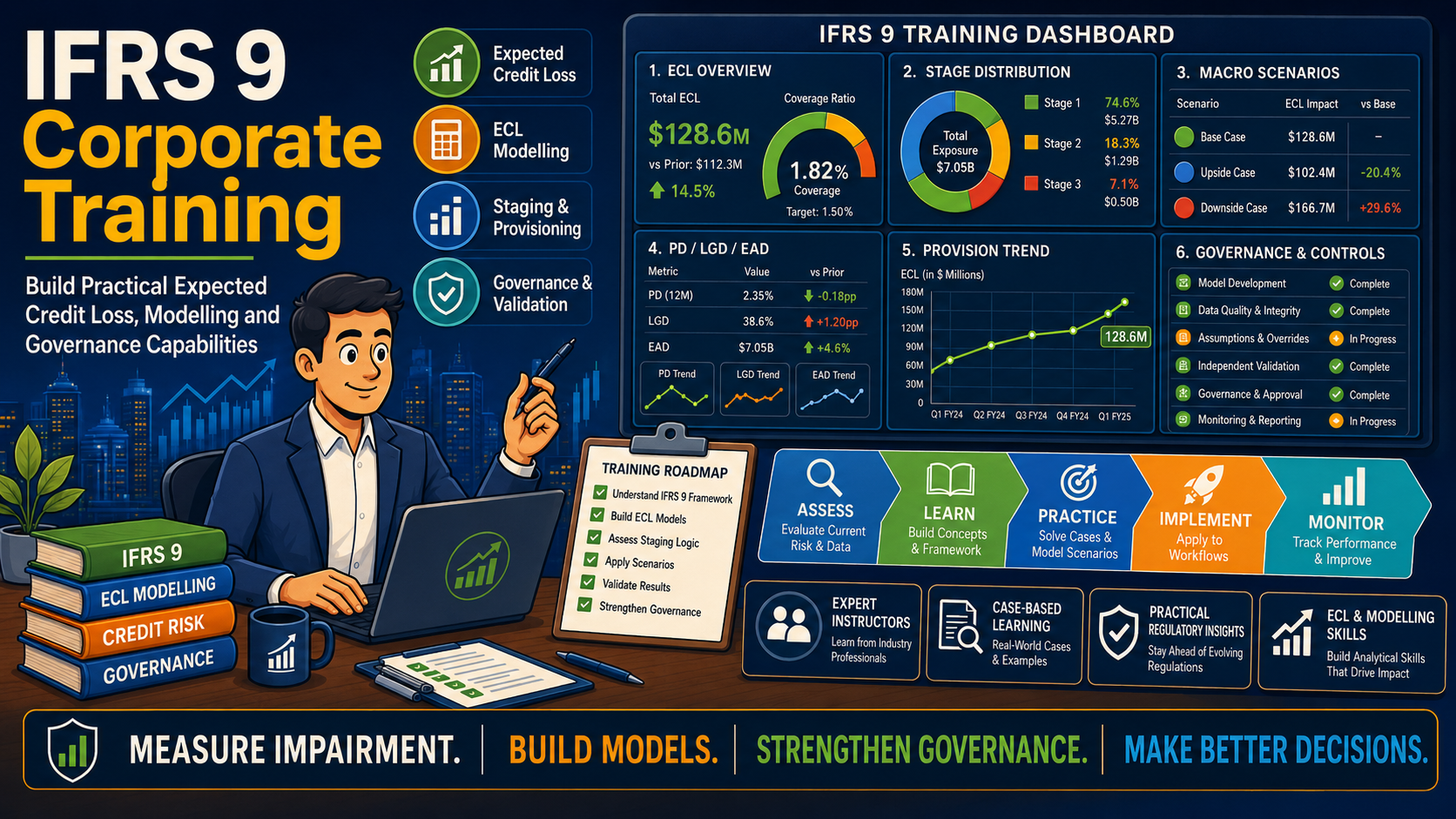
Expected Credit Loss, or ECL, is an important concept in modern credit risk and IFRS 9 modelling.
Expected Credit Loss combines PD, LGD and EAD to estimate possible credit losses.
A good training program should teach:
- Expected loss logic
- PD x LGD x EAD framework
- IFRS 9 overview
- Stage 1, Stage 2 and Stage 3 assets
- Lifetime expected credit loss
- Forward-looking information
- Macroeconomic scenarios
- ECL interpretation
This topic is highly relevant for banks, NBFCs, auditors, consultants and risk professionals.
7. Credit Scorecard Modelling
Credit scorecards are widely used in retail lending, personal loans, credit cards, SME loans and fintech lending.
A scorecard gives borrowers a risk score based on borrower characteristics and past behaviour.
Important scorecard topics include:
- Application scorecards
- Behavioural scorecards
- Variable selection
- Data binning
- Weight of Evidence
- Information Value
- Logistic regression
- Score scaling
- Cut-off selection
- Risk grades
- Model validation
- Scorecard interpretation
Credit scorecard modelling is one of the most practical skills in credit risk analytics.
8. Credit Rating Models
Credit rating models are used for corporate borrowers, SME lending, institutional credit assessment and project finance.
These models combine financial and non-financial factors to assign borrower risk grades.
A credit rating model may consider:
- Financial ratios
- Business profile
- Industry risk
- Management quality
- Cash flow strength
- Debt repayment capacity
- Collateral
- External environment
- Qualitative risk factors
Rating models help lenders decide approval, pricing, exposure limits and monitoring frequency.
9. Portfolio Credit Risk
Credit risk is not only about one borrower. Banks and NBFCs must also monitor the risk of the entire loan portfolio.
Portfolio credit risk training should include:
- Sector concentration
- Geographic concentration
- Vintage analysis
- Delinquency trends
- Default rate tracking
- Migration analysis
- Roll-rate analysis
- Stress testing
- Portfolio expected loss
- Credit risk dashboards
A portfolio can become risky even if individual loans appear acceptable. That is why portfolio-level monitoring is essential.
10. IFRS 9 Credit Risk Modelling
IFRS 9 credit risk modelling is important for expected credit loss calculation and financial reporting.
A practical training program should introduce:
- IFRS 9 impairment framework
- Significant increase in credit risk
- Stage 1, Stage 2 and Stage 3 classification
- Lifetime ECL
- Forward-looking macroeconomic scenarios
- PD, LGD and EAD under IFRS 9
- Model governance and documentation
This topic is useful for learners interested in banking, NBFCs, audit, consulting and regulatory risk roles.
11. Basel Credit Risk Training
Basel credit risk concepts are important for banking risk management and regulatory capital.
Training may include:
- Basel credit risk framework
- Standardised approach
- Internal ratings-based approach
- Regulatory capital
- Risk-weighted assets
- Capital adequacy
- Stress testing
- Model validation
- Credit risk governance
Basel training helps learners understand how credit risk links with capital management and regulatory compliance.
12. Python for Credit Risk Modelling
Python is now one of the most important tools for credit risk analytics. It helps learners work with larger datasets, build statistical models and automate risk analysis.
Python can be used for:
- Data cleaning
- Missing value treatment
- Exploratory data analysis
- Logistic regression
- Credit scorecard development
- Model validation
- Portfolio analytics
- Default prediction
- Data visualisation
- Risk report automation
Important Python libraries include Pandas, NumPy, Matplotlib, Scikit-learn and Statsmodels.
A learner who understands both credit risk concepts and Python implementation has a stronger profile for modern risk analytics roles.
13. Excel for Credit Risk Modelling
Excel is still widely used in finance and risk teams. It is useful for model structure, formulas, dashboards, scenario analysis and management reporting.
Excel can be used for:
- Financial ratio analysis
- Credit appraisal models
- Rating templates
- Scorecard summaries
- Scenario analysis
- Sensitivity analysis
- Portfolio dashboards
- Expected loss calculations
- Management reports
A strong learner should not think of Excel and Python as competitors. Excel helps with model clarity and presentation. Python helps with scale, automation and advanced analytics.
14. Credit Risk Modelling Using Python and Excel
The best practical training combines Python and Excel.
Excel helps learners understand:
- Model layout
- Assumptions
- Formula flow
- Output presentation
- Management reporting
Python helps learners handle:
- Large datasets
- Automation
- Statistical modelling
- Machine learning
- Data cleaning
- Model validation
Together, Python and Excel create a strong skill set for credit risk modelling and financial analytics.
15. Graded Assignments and Projects
Credit risk modelling training should include assignments and projects. Without practice, learners may understand theory but fail during real implementation.
Useful project examples include:
- Borrower financial analysis project
- Credit scorecard model
- Probability of Default model
- Expected Credit Loss calculation
- IFRS 9 staging model
- Credit rating model
- Loan portfolio dashboard
- Delinquency trend analysis
- Vintage analysis
- Stress testing model
- Python-based default prediction model
- Excel-based credit appraisal model
Projects help learners build confidence and create real examples to discuss in interviews.
Career Opportunities After Credit Risk Modelling Training
Credit risk modelling training can support career preparation for roles in banks, NBFCs, fintech companies, consulting firms, credit rating agencies, audit firms and analytics companies.
Possible job roles include:
- Credit Analyst
- Credit Risk Analyst
- Risk Analyst
- Portfolio Risk Analyst
- Banking Analyst
- Model Risk Analyst
- Risk Consultant
- Credit Rating Analyst
- Financial Analyst
- Fintech Risk Analyst
- Risk Analytics Associate
- Loan Portfolio Analyst
- Model Validation Analyst
These roles require a combination of finance knowledge, data skills, modelling ability and business judgement.
Why Choose Peaks2Tails for Credit Risk Modelling Training?
Peaks2Tails is suitable for learners who want practical finance and risk modelling education instead of passive theory-based learning.
The learning ecosystem focuses on:
- Credit risk modelling
- Quantitative finance
- Risk modelling
- Python for finance
- Excel for finance
- Financial analytics
- Real-world case studies
- Assignments
- Projects
- Certification-focused learning
- D-Forum discussion support
For credit risk modelling, this structure matters because the subject cannot be mastered through definitions alone. Learners need to work with data, build models, test assumptions and interpret results.
Peaks2Tails helps learners move from theory to implementation by combining finance concepts with Excel, Python and practical model-building.
Online Credit Risk Modelling Training: Is It Worth It?
Yes, online credit risk modelling training can be valuable if it includes proper structure, practical exercises, assignments, projects and doubt support.
A weak online course only gives recorded videos. A strong online training program gives:
- Structured curriculum
- Concept clarity
- Excel demonstrations
- Python implementation
- Case studies
- Assignments
- Projects
- Doubt-solving support
- Certification
- Career-focused guidance
Online learning gives flexibility, but learners must be disciplined. Watching videos passively will not build real skill. Credit risk modelling requires practice.
Skills Needed to Become Strong in Credit Risk Modelling
To become strong in credit risk modelling, learners need a mix of finance, statistics, tools and business understanding.
Important skills include:
- Financial statement analysis
- Banking product knowledge
- Excel modelling
- Python programming
- Basic statistics
- Regression analysis
- Data cleaning
- Credit scorecard development
- Risk interpretation
- Model validation
- Report writing
- Business communication
The strongest candidates are not those who only know formulas. The strongest candidates can explain why a model works, what its output means and how it affects lending decisions.
Common Mistakes Learners Should Avoid
Many learners approach credit risk modelling the wrong way.
Avoid these mistakes:
- Learning only theory
- Ignoring Excel practice
- Avoiding Python
- Memorising formulas without understanding logic
- Not working with datasets
- Not building projects
- Not learning financial statement analysis
- Not practising model explanation
- Treating certification as the only goal
- Copying models without understanding assumptions
A certificate may support your profile, but your real value comes from your ability to build, interpret and explain credit risk models.
How to Start Credit Risk Modelling Training
Beginners should follow a proper learning path.
A practical roadmap is:
- Understand banking and lending basics
- Learn credit risk fundamentals
- Study financial statement analysis
- Learn PD, LGD and EAD
- Build credit scorecards
- Study credit rating models
- Learn IFRS 9 credit risk modelling
- Understand Basel credit risk concepts
- Practise Excel-based credit models
- Learn Python for credit risk analytics
- Work on projects and case studies
- Prepare your CV and interview answers
This structured approach is much better than randomly learning disconnected topics.
Conclusion
Credit risk modelling training is one of the most practical learning paths for anyone who wants to build a career in banking, NBFCs, fintech, consulting, credit analytics or financial risk management.
Credit risk modelling helps learners understand borrower behaviour, estimate default risk, calculate expected loss, build credit scorecards, analyse portfolios and support better lending decisions. With Excel and Python, learners can move beyond theory and develop real job-ready skills.
Peaks2Tails provides a practical learning ecosystem for students and professionals who want to master credit risk modelling, quantitative finance, Python, Excel and financial analytics. If your goal is to build strong finance skills, improve your CV and become confident in real-world risk modelling, then credit risk modelling training is a smart career investment.
The real outcome of training should not be only a certificate. The real outcome should be the ability to build models, interpret data and explain credit risk decisions clearly.
FAQ
Q1. What is credit risk modelling training?
Credit risk modelling training teaches how to assess borrower risk, estimate Probability of Default, calculate expected loss, build credit scorecards and use Excel or Python for credit risk analytics.
Q2. Who should join credit risk modelling training?
Finance students, MBA students, CFA and FRM candidates, credit analysts, banking professionals, risk analysts and career switchers can join this training.
Q3. Is credit risk modelling useful for jobs?
Yes. It is useful for jobs in banking, NBFCs, fintech, credit rating, consulting, financial analytics and risk management.
Q4. Do I need Python for credit risk modelling training?
Python is not compulsory for beginners, but it is highly useful for data cleaning, scorecard development, logistic regression, default prediction, portfolio analytics and report automation.
Q5. Is Excel still important for credit risk modelling?
Yes. Excel is still widely used for financial analysis, credit appraisal, rating templates, dashboards, scenario analysis and management reporting.
Q6. What is PD in credit risk modelling?
PD means Probability of Default. It estimates the likelihood that a borrower may default within a specific time period.
Q7. What are LGD and EAD?
LGD means Loss Given Default, which measures the loss percentage if default happens. EAD means Exposure at Default, which estimates the outstanding exposure when default occurs.
Q8. Does credit risk modelling training include IFRS 9?
A good credit risk modelling training program should include IFRS 9 concepts such as expected credit loss, staging, lifetime ECL and forward-looking scenarios.
Q9. What projects can I build in credit risk modelling training?
You can build credit scorecards, PD models, expected credit loss models, credit rating models, loan portfolio dashboards, vintage analysis reports and stress testing models.
Q10. Why choose Peaks2Tails for credit risk modelling training?
Peaks2Tails focuses on practical quantitative finance and risk modelling education with credit risk, Python, Excel, assignments, projects, case studies and career-focused learning.